Many people received DNA kits for Christmas and are now anxiously awaiting the results to learn more about themselves, their ancestors, and ethnicity. Others are seeking family members or to learn where they came from. Genetic genealogy is at the heart of their search, but the results can be confusing. In order to help those on their journey we wanted to provide a step by step look into matching DNA family back to you.
If you’re looking for help understanding your DNA matches and how they relate to you, this is a service we provide. See our Genealogy Services section for more details.
“In all of us there is a hunger, marrow deep, to know our heritage – to know who we are and where we come from.” Alex Haley
Below is a basic example of how DNA matches are sorted and family trees are built out to provide you answers.
There are a number of ways to go about genetic genealogy, but what it boils down to is having an individual’s genetic profile and a list of DNA matches. Individuals are matched based on the number of centimorgans shared.
A centimorgan is a unit of genetic measurement (abbreviated cM). Different experts estimate that a person has between 6,800 and 7,200 centimorgans; for that reason, 7,000cM is typically used as the average total. This means that a person receives roughly 3,500cM from each parent. Below is a visual representation, available as a tool at DNA Painter, showing the expected number of shared cM between different family members.
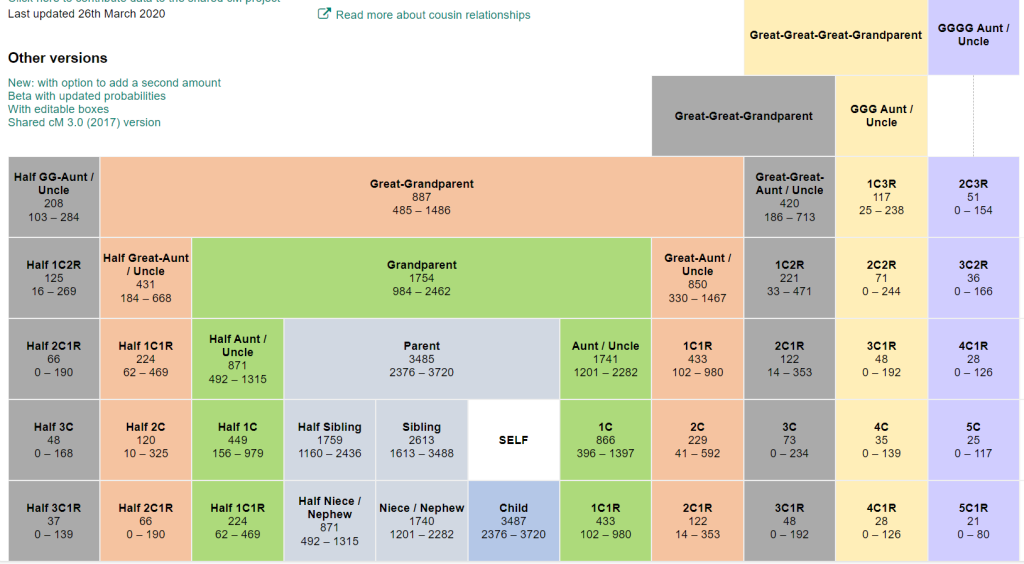
To demonstrate how DNA relatives are connected to the tester, I’ll go through the hypothetical genetic genealogy connecting a made up man I’ll call John Doe, born 1952, to his paternal family. John knows nothing about his father or his father’s family as his mother has kept it a secret. The only information John has been given by his mother was that she gave him his biological father’s last name.
Hypothetic John had a number of good matches on his paternal side of the family.
His closest match was Catherine Johnson, with whom he shared 664cM; this makes her most likely his first cousin, the daughter of one of his father’s siblings.
John’s second best match was Laura Davis, with whom he shared 531cM, putting her in the first or second cousin range.
His third closest match was Betsy Matthews, with whom he shared 357cM; this meant she was likely John’s first cousin once removed.
John’s fourth closest match was Cathy Williams, with whom he shared 283cM, making her mostly likely his second cousin.
(These are normal expectations for relatives, but there can always be outliers. This is why all connections are considered “most likely”. This also doesn’t take into consideration endogamy. Edogamy occurs in local communities where the spousal options are limited over several generations, creating a higher than expected genetic similarity. In layman’s terms it causes distant cousin matches to appear as closer cousins; making DNA analysis more complex.)
Below is a basic look at hypothetical John’s top paternal DNA matches and how they might fit into the tree. This example shows only their potential tree location and cMs of shared DNA.
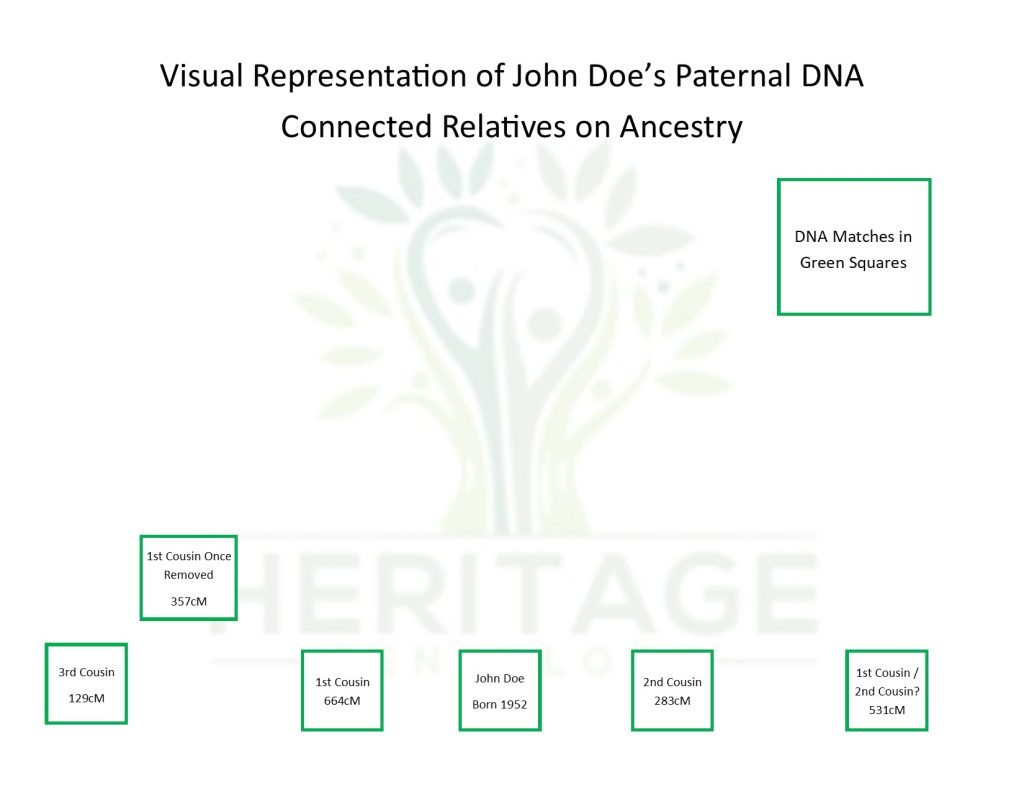
These are excellent matches to work with; not always is a genetic genealogist presented with first and second cousins, but for the purpose of demonstrating how the work is done, I wanted to provide a simple situation.
First Match Catherine Johnson
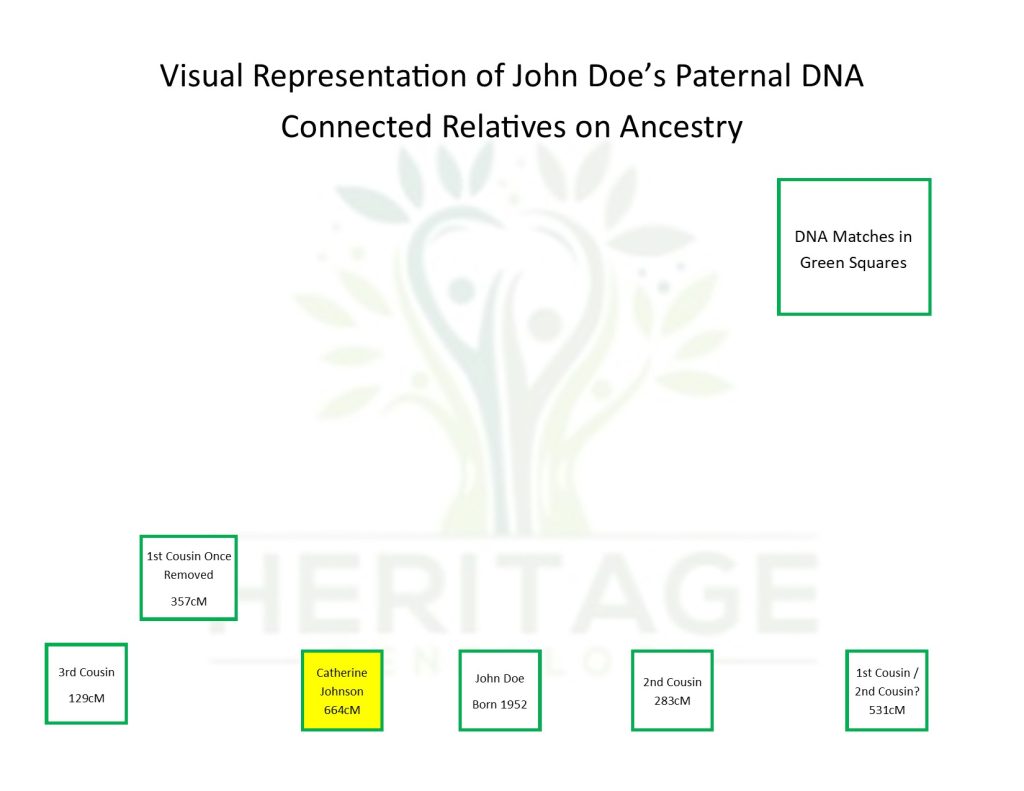
The work begins with the strongest match, Catherine Johnson, sharing 664cM. As a genetic genealogist, I start by building out Catherine’s tree. If they are indeed first cousins, John’s father will be a sibling of one of Catherine’s parents.
In this case, Catherine’s online information is under her married name. Catherine’s maiden name is Adams, and her parents are John Adams and Cynthia Doe. This is exactly what I was looking to find, the shared surname of Doe. A shared surname supports the hypothesis that John’s father and Catherine’s mother are siblings.
Next, is further research into the family of Cynthia Doe. Cynthia was born in 1911 and appears in the 1920 and 1930 US Census records with her siblings and parents. Cynthia’s father is Michael Doe, born about 1885 and her mother is Mary Smith, born about 1890. Cynthia has three siblings listed: Anthony Doe, James Doe, and Lawrence Doe.
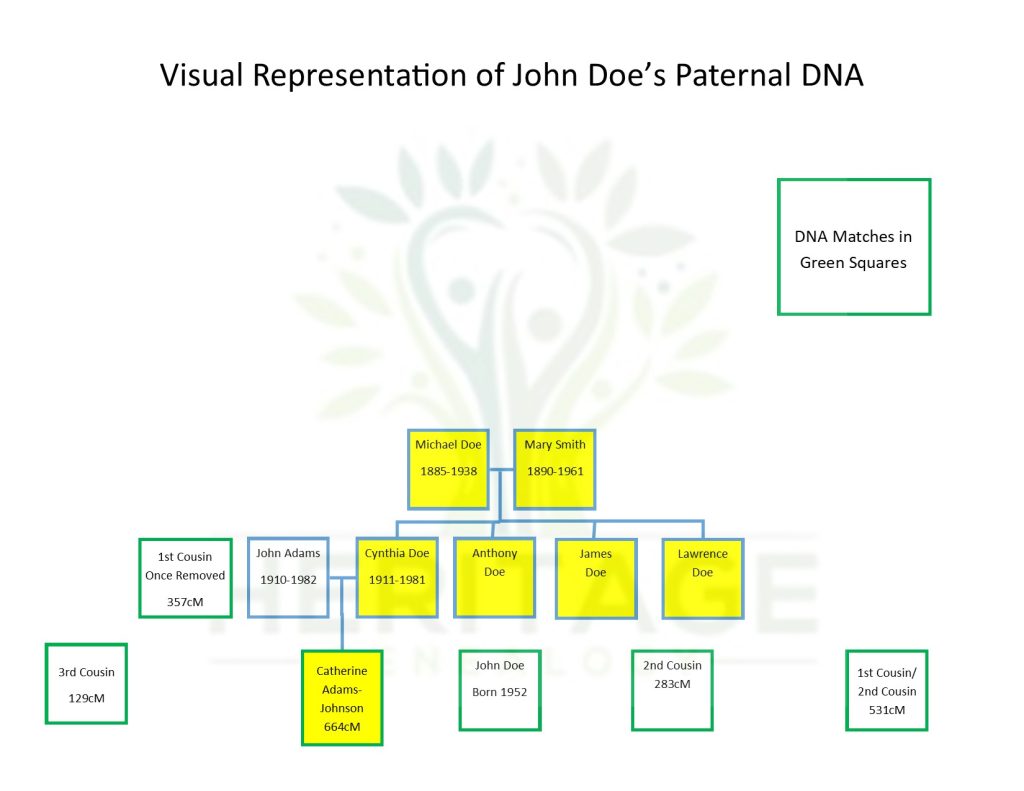
Here the family of Catherine is added to the tree. The focus on Catherine’s family is based on her mother’s matching surname to our hypothetical John. If Catherine’s mother is indeed the sister of John’s father, then John’s father is either Anthony, James or Lawrence. More work has to be done to connect John to one of these men or rule them all out.
I’ve added Catherine’s grandparents on the Doe side of the family. More than likely, as the tree builds out, this information will be required to connect additional family members.
As a side note, if on an actual case, the client presents with a very common surname such as Smith, I would have built out both sides of the family tree.
With the surname Doe matching John’s, I have added one additional generation in the next image, Michael’s parents, hoping this area of the tree would continue to produce matches. Michael’s parents are George Doe, born about 1850, and Margaret Blackman, born about 1856.
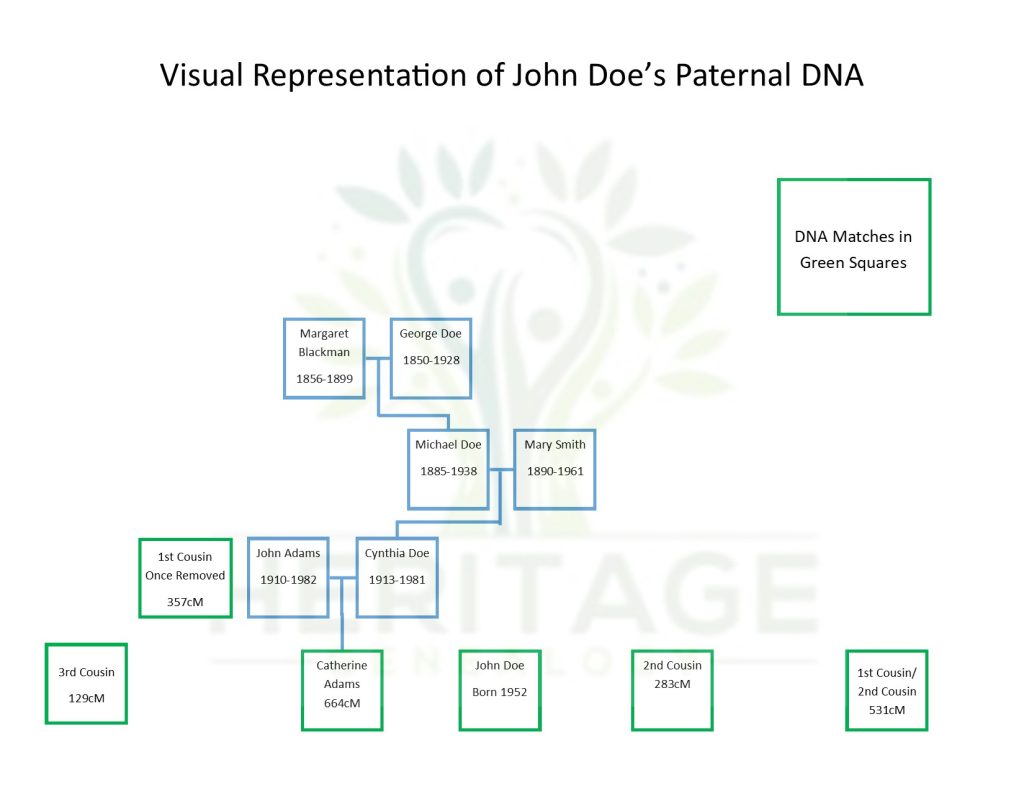
Here is where processes differ. Some genetic genealogists would start by digging into each brother to find out more about the Doe family. Determining if each brother lived into adulthood can be a very easy way to eliminate potential fathers. Instead of going with a deep dive into each brother, the process I’m demonstrating is building out information on each of the closest DNA relatives first to find intersecting family members.
Hypothetical John’s second highest match is Laura Davis. After a brief look into Laura, Davis is clearly her married name, with no readily available information on her maiden name and no linked family tree. This one I will save for further investigation later.
Second Match – Laura Davis
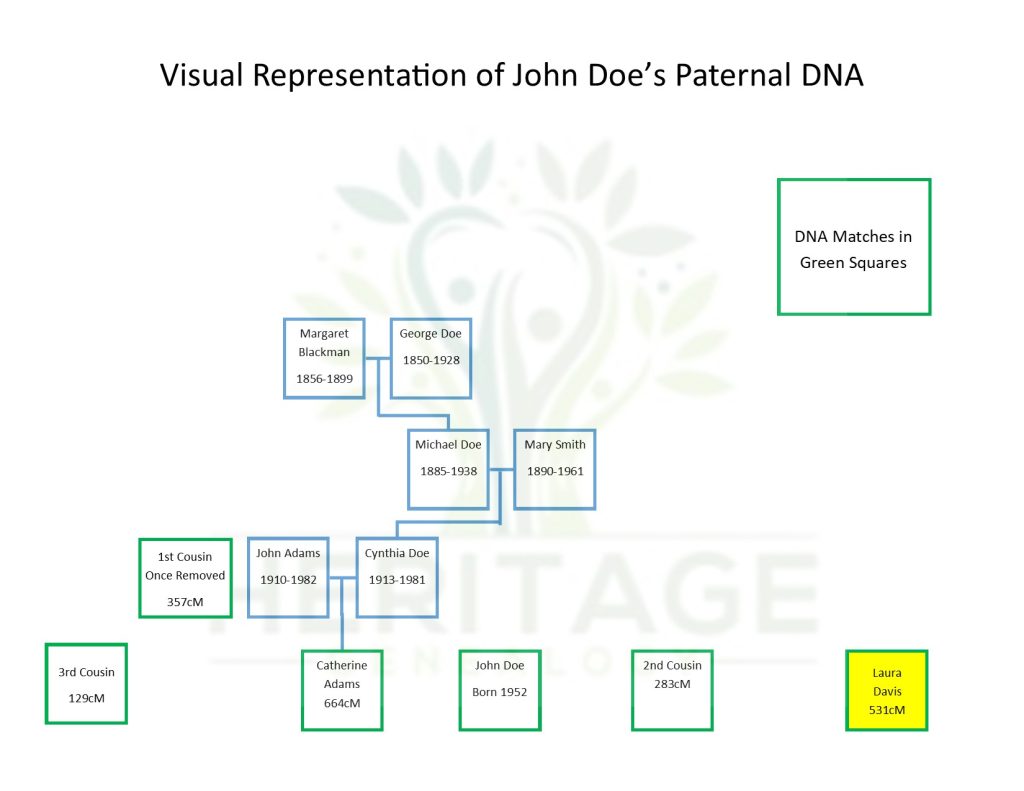
I continue on to hypothetical John’s third highest match, Betsy Matthews. Betsy’s information is also listed under her married name. Her profile is managed by someone other than Betsy, but it does include Betsy’s parents names.
Third Match – Betsy Matthews
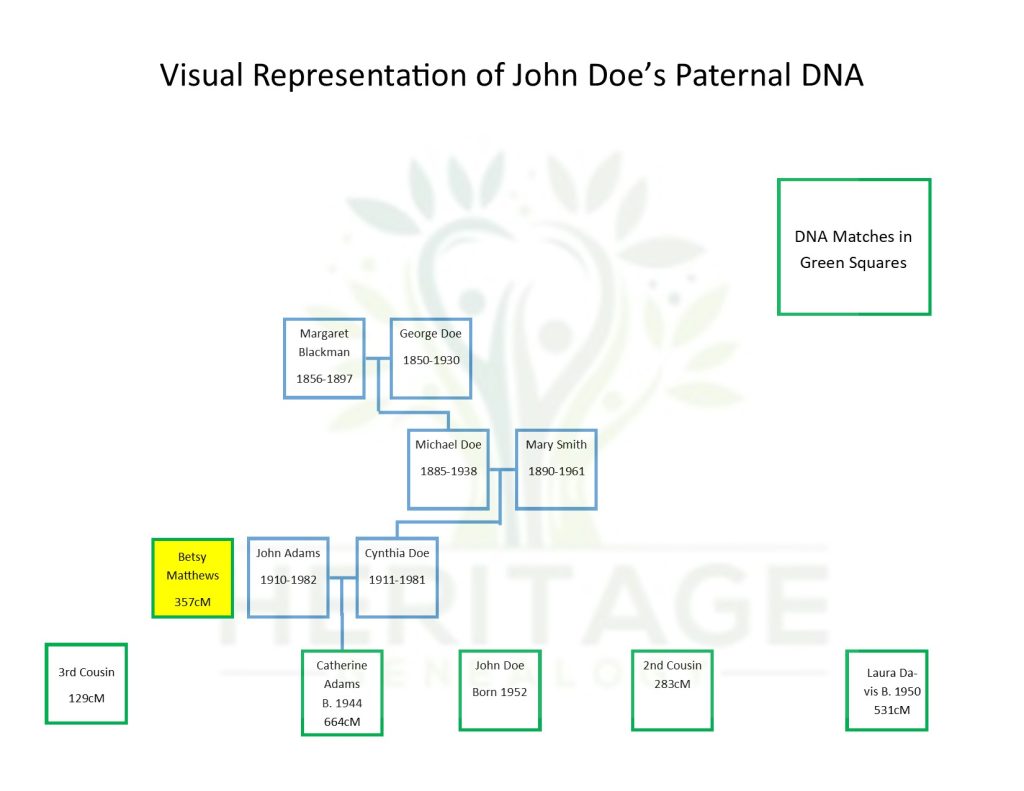
Betsy’s maiden name is Doe, and her parents are Richard Doe and Martha Miller. This is another excellent connection to the Doe family.
Looking further into Richard Doe, I found exactly the connection I was hoping would be there. Betsy’s father, Richard Doe, and Catherine’s grandfather from the first high match, Michael Doe, are siblings. They are both the children of George Doe and Margaret Blackman.
Reviewing the shared DNA matches report confirms that John and Betsy show Catherine as a common match.
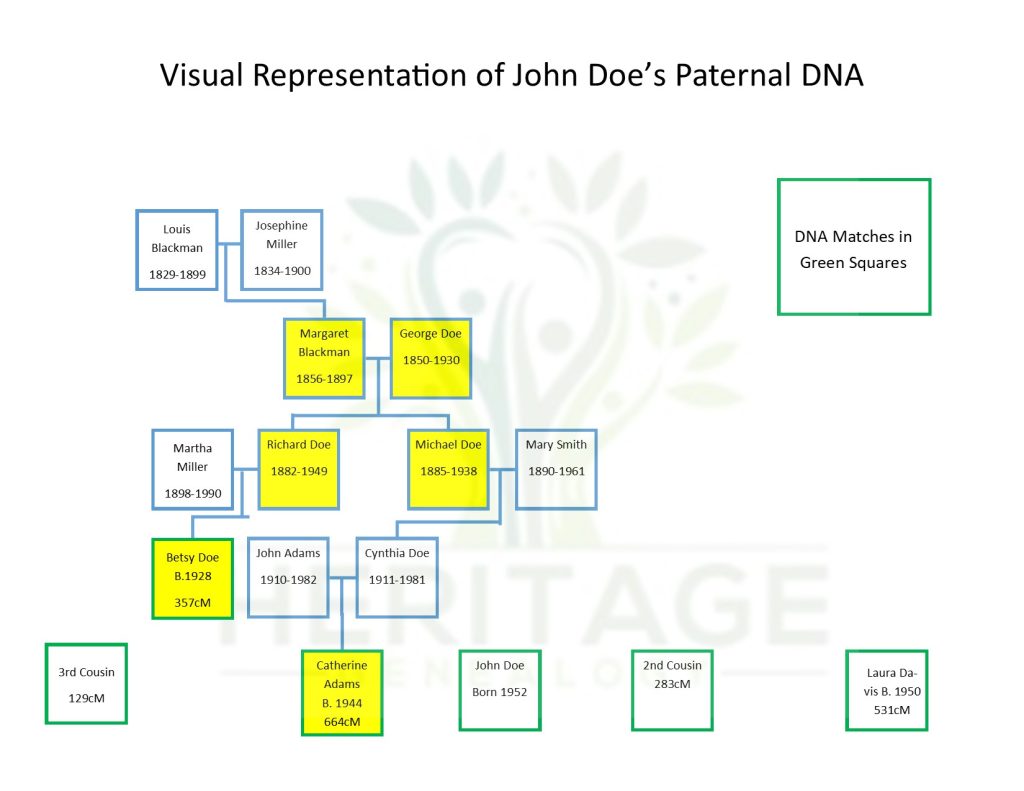
This is now a strong connection both to the surname and shared matches. I add another generation for Margaret Blackman; her parents, Louis Blackman, born about 1829, and Josephine Miller, born about 1834. At this time, I was unable to conclusively add an additional generation for George Doe.
As a general guide you can now see the process as it moves down the list of connections.
The next closest DNA match for hypothetical John is Cathy Turner, sharing 283cM with John.
Fourth Match – Cathy Turner
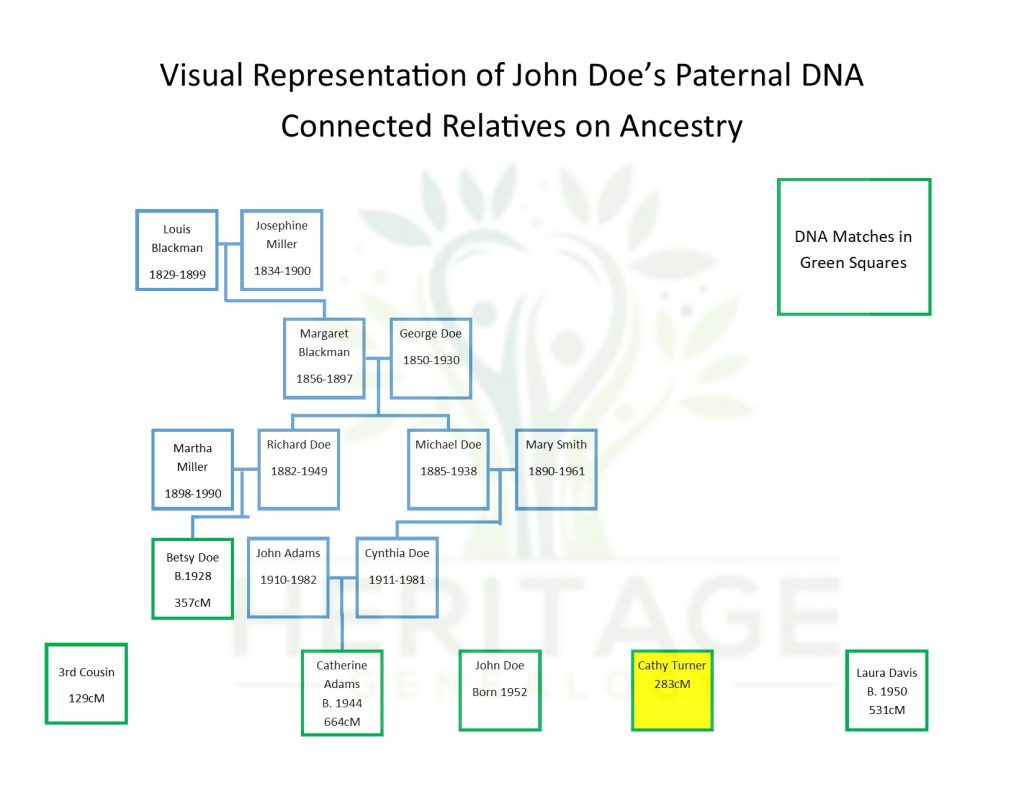
Cathy did have an online tree available, and with her parents being deceased, they were readily identified along with her maiden name of Williams.
Cathy’s parents were Allison Smith, born about 1920, and Tony Williams, also born about 1920. As Smith is the maiden name of Michael Doe’s wife, I focused my search on Allison’s family. (As I mentioned before, if the real last name were something as common as Smith, I would be less likely to focus in a single direction, and would instead build out both sides of the family tree.)
Allison Smith’s parents were Peter Smith, born about 1880, and Victoria Williams, born about 1890.
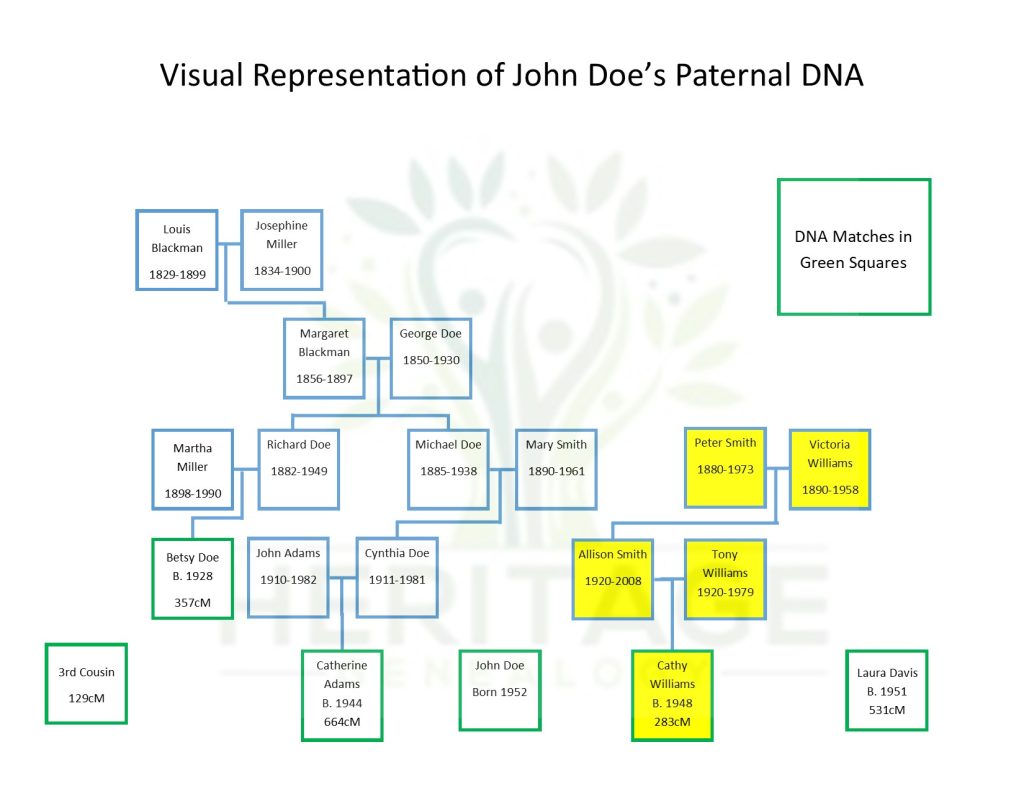
Peter was the son of Anthony Smith, born about 1853, and Aubrey Jones, born about 1860. Among the children listed on the US Census for the Smith family is a daughter named Mary, born in 1890. Further research confirms that this Mary Smith is the same Mary Smith who married Michael Doe.
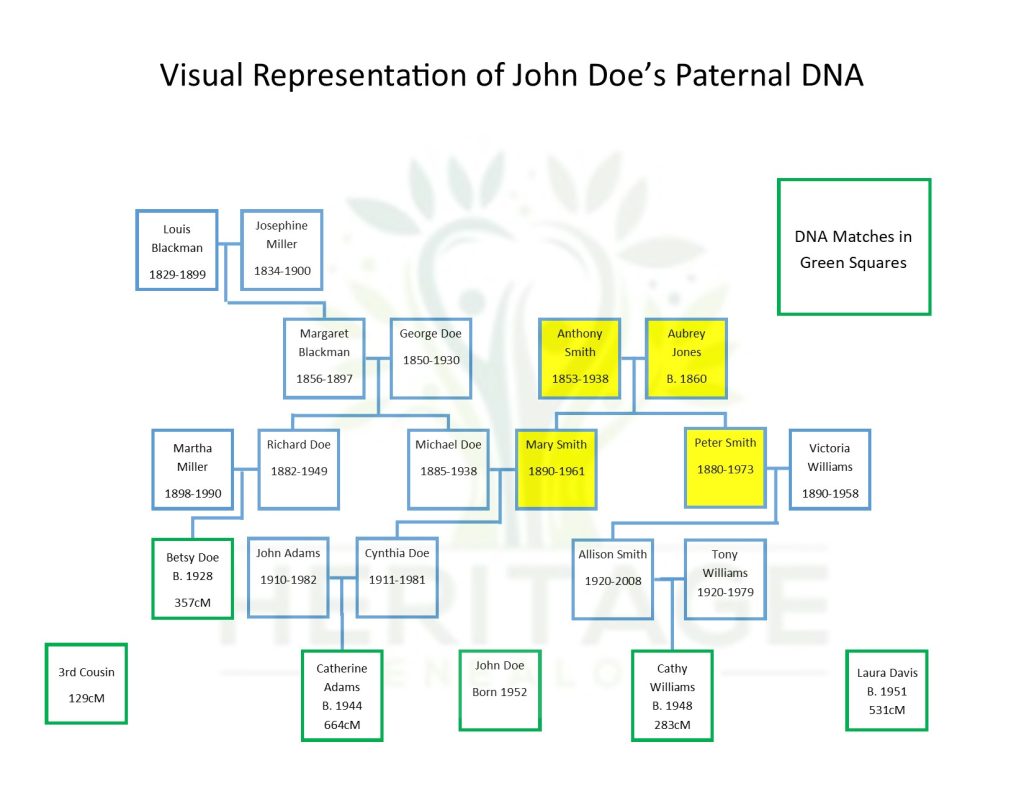
Between Michael Doe and Mary Smith, I have found solid DNA matches to John Doe.
At this point, it is clearly indicating that John Doe is a grandchild of Michael Doe and Mary Smith.
The only plausible alternative that should be looked into is if there is another marriage located between the children of George Doe and Margaret Blackman and Anthony Smith and Aubrey Jones. For example, if two sisters married two brothers. This would create a scenario where you would find similar cousin DNA matches between cousins.
For the sake of simplification, that did not happen in the family of hypothetical John.
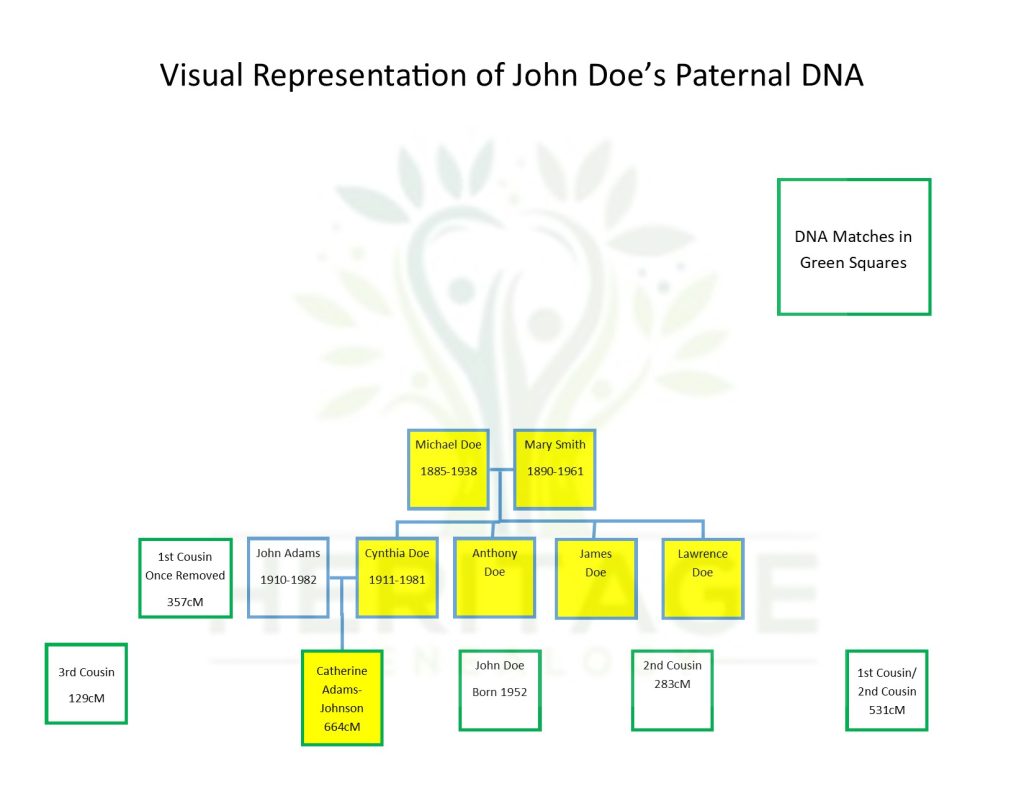
I will now go back and look into the children of Michael Doe and Mary Smith, the siblings of Cynthia Doe, Anthony Doe, James Doe, and Lawrence Doe.
Lawrence Doe, born about 1928, was the quickest to be eliminated. He was recorded as dying young in 1938 and was buried in the same plot as his father and mother. Having only reached the tender age of ten, he was clearly not the father of John.
Anthony was born about 1915 and died at the age of 22 in 1937. As John was not born until 1952, this eliminated Anthony as the father as well.
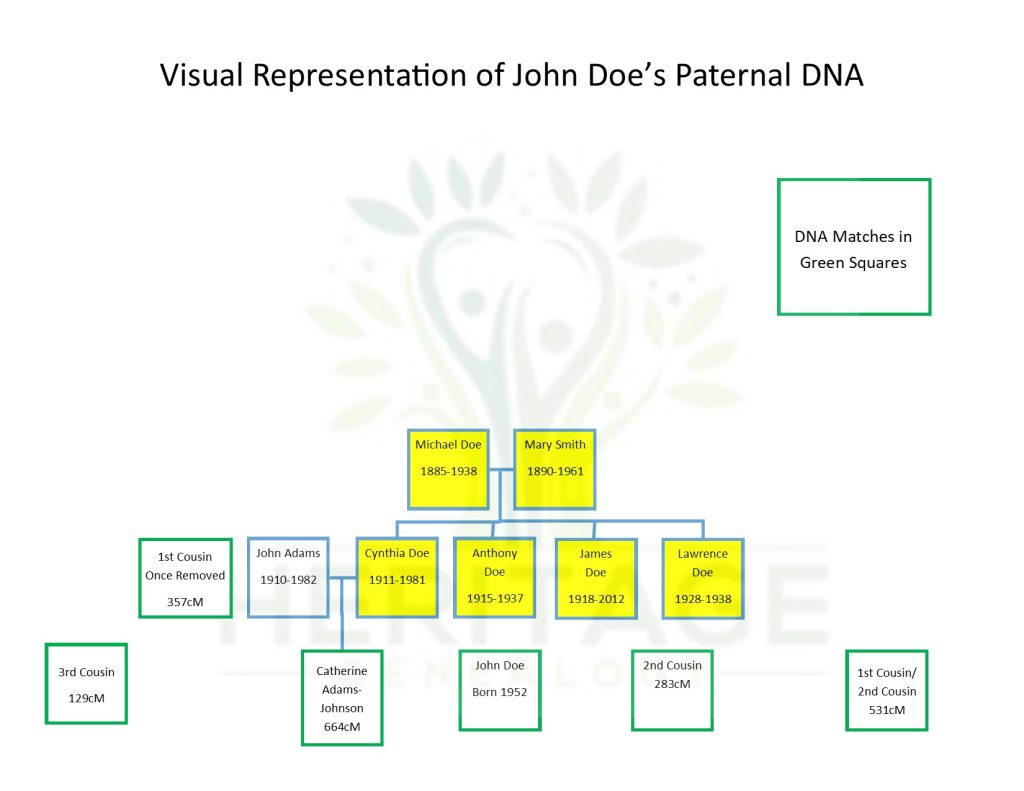
This leaves the only other known son of Michael Doe and Mary Smith, James Doe, as the father of John Doe. James Doe did have several other children; should someone like hypothetical John choose to reach out to his half siblings, that would be the most concrete way, outside of testing James’ DNA, if he were still alive, to prove John is the son of James.
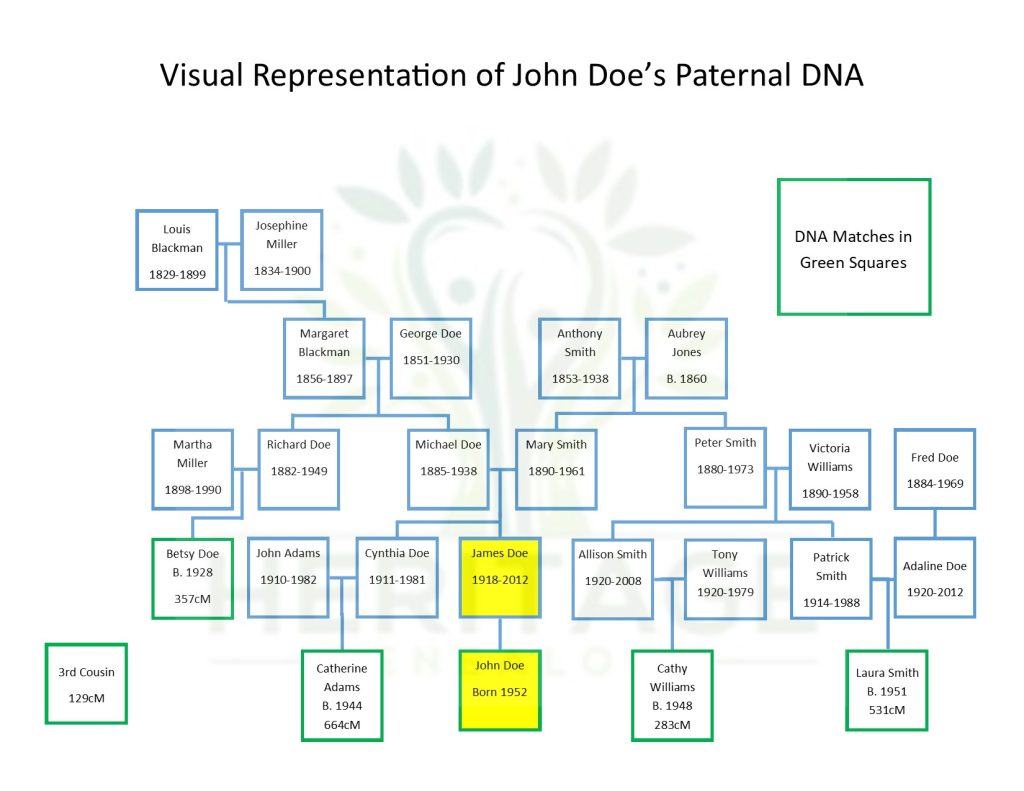
An argument can be made that I should have investigated them first. However, even if I had done that and determined that Anthony and Lawrence did not have any children, to fully confirm the relationship, I would have still needed to go through and verify the relationship with John’s other high matches to demonstrate the strength of those relationships.
If this was the case of unknown male DNA, there is evidence of an absolute DNA match to a grandchild of Mary Smith and Michael Doe. The match can’t be to a child of Cynthia Doe, as that DNA match would be much higher and show as a sibling match to Catherine, not a first cousin match. The two other siblings of James and Cynthia have been eliminated as dying before having children. So the conclusion is sound, and should the same raw data be provided to another genetic genealogist, the same conclusion is the only one that fits together the DNA matches without any outliers.
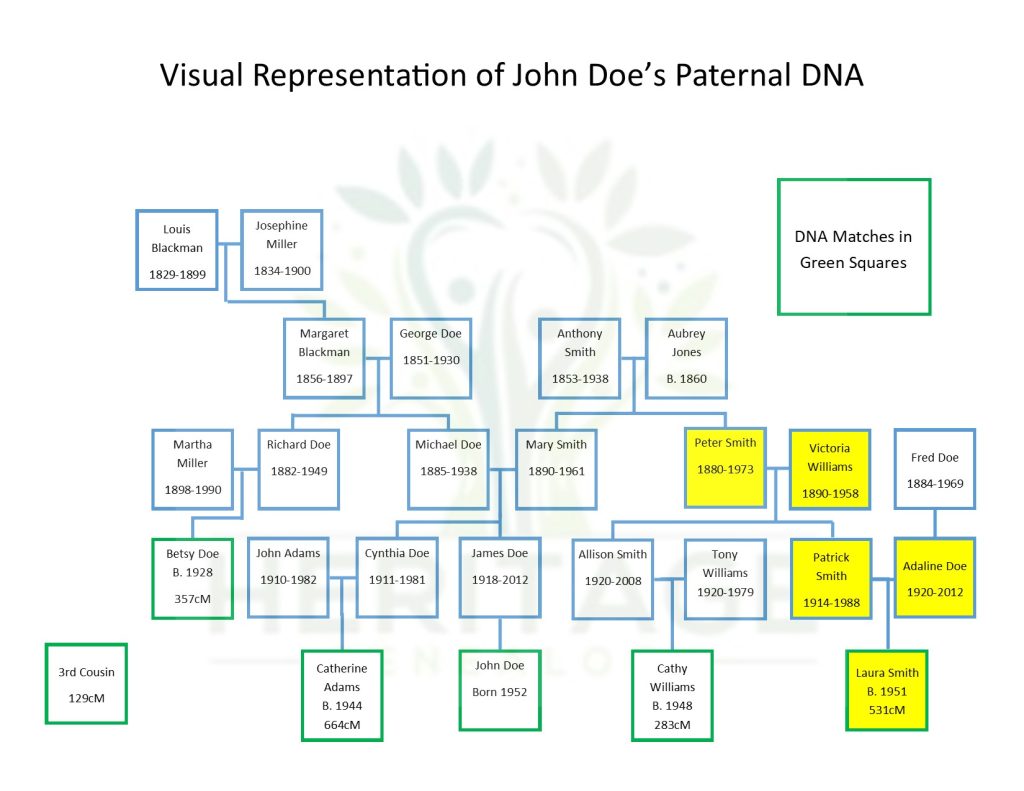
I proceed to really clean the tree up, as there is one outlier right now, Laura Davis. With further expansion of the Smith side of the tree, as Laura shows Cathy as a high common match with John, I found that Laura’s maiden name is also Smith.
Laura is the daughter of Patrick Smith, Allison Smith’s brother, and his wife, Adaline Doe. Patrick was born about 1914 and is the son of Peter Smith and Victoria Williams. This makes Laura another second cousin of John’s, however, with a higher than expected number of centimorgans in common. This may be a result of Laura’s mother, Adaline Doe, sharing the surname with John’s grandfather. There is a good chance that further research into Adaline’s family will locate a Doe relative in common, increasing the amount of shared DNA between John and Laura.
This type of result can be found in small communities where over the years many families have intermarried. In small enough communities you see endogamy; this is where descendants of people from this community share unusually significant amounts of DNA due to the families intermarrying frequently over the generations. The result is distant relatives seeming to be closer, genetically speaking.
Back to Laura Davis / Smith
Lastly, to round out the matches a little further, there is a third cousin match to Andrew Brown Jr., who shares 129cM with hypothetical John.
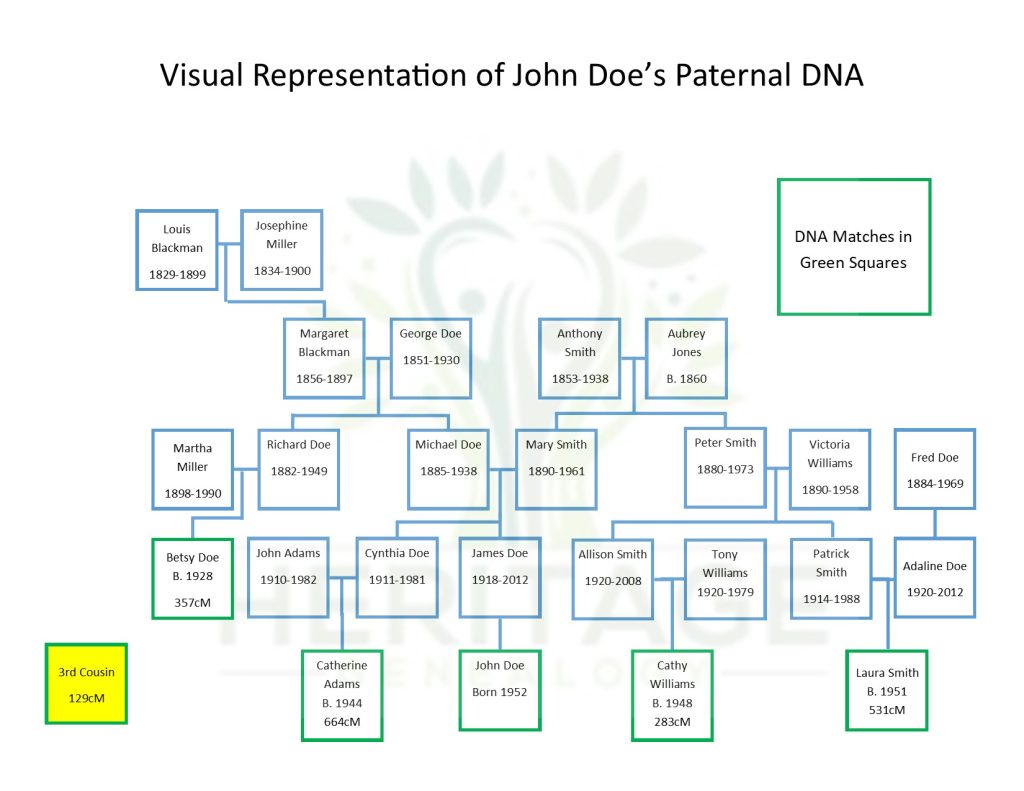
Andrew recently passed away but is in a tree managed by a family member, which provides clarity on the relationship to John. Andrew’s father is Andrew Sr. and Andrew Sr.’s father was Marcus Brown, who was the son of Joseph Brown, born about 1859, and Isabelle Blackman, born about 1864. Isabelle is another daughter of a family I already documented in the tree, Louis Blackman and Josephine Miller.
Often I am presented with a number of matches closer to the 150cM range. This connection to Andrew demonstrates how much farther trees must be built out in order to connect DNA relatives.
Fifth Match – Andrew Brown Jr.
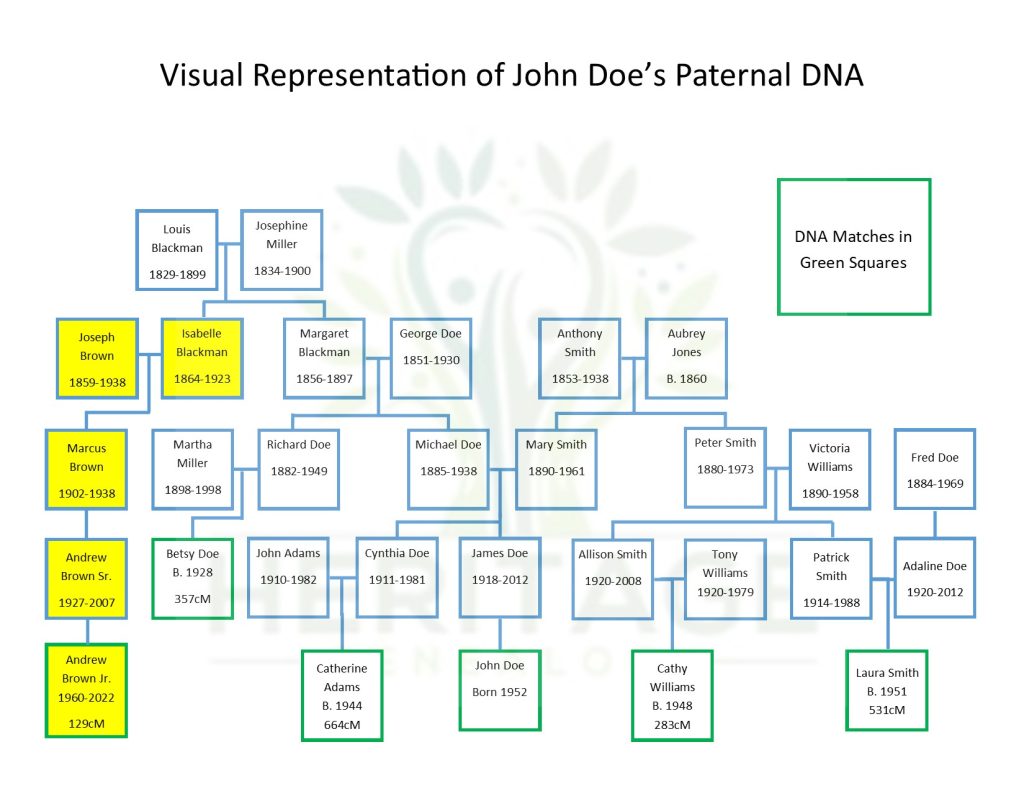
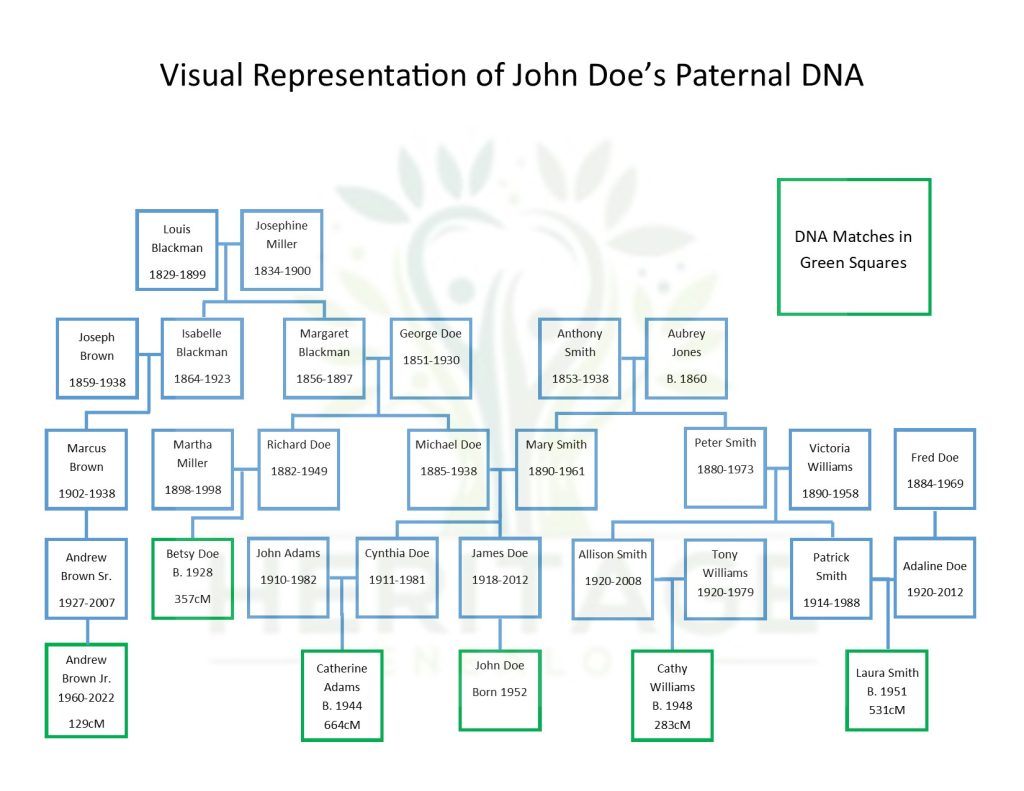
Here is the detailed paternal tree laid out for hypothetical John; he now has a clear idea of how he fits into his paternal family.
If you have further questions about genetic genealogy or are looking to hire someone to help you Find Your Family or work on any other genetic genealogy project, don’t hesitate to Contact Us.